To request a media interview, please reach out to experts using the faculty directories for each of our six schools, or contact Jess Hunt-Ralston, College of Sciences communications director. A list of faculty experts is also available to journalists upon request.
News Center
Latest News

Assistant Professor Saumya Jain received a grant to support research on how genes shape neural connectivity and behavior.

Research suggests that vast mats of smelly seaweed may have entered a self-sustaining cycle, effectively feeding their own expansion. It’s creating a chronic disaster for the affected coasts, with little sign of ending.
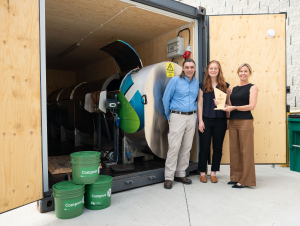
Georgia Tech’s in-vessel composting program earns national recognition.

Yuanzhi Tang, executive director of the Strategic Energy Institute (SEI) and Georgia Power Professor in the School of Earth and Atmospheric Sciences, has been named an American Chemical Society (ACS) Fellow.
The ACS is one of the world’s largest scientific societies, and its Fellows Program recognizes outstanding achievements in scientific research, education, leadership, and service to the chemical profession and honors a select group of members each year.
"Election as an ACS Fellow is a significant honor that recognizes not only scientific excellence but also leadership and service to the profession," said Julia Kubanek, Georgia Tech's vice president for Interdisciplinary Research. "Yuanzhi's pioneering research, her leadership within ACS and the Strategic Energy Institute, and her commitment to advancing interdisciplinary collaboration have strengthened Georgia Tech's impact in chemistry, energy, and environmental research. We are proud to celebrate this well-deserved recognition."
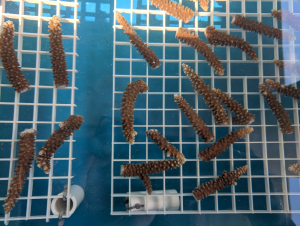
Georgia Tech researchers found that predatory bacteria can halt the spread of a destructive coral disease by hunting and consuming pathogens responsible for the infection.
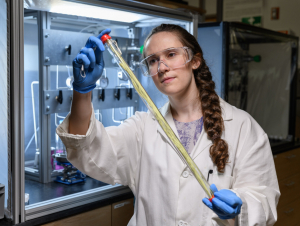
Georgia Tech researchers will lead two projects and contribute to several others as part of the Department of Energy’s $5 billion initiative.
Experts In The News
For most of the industrial era, spreading crushed limestone across farmland has been treated as a carbon problem. The rock contains carbon; it ends up in contact with air and water, and by the most conservative accounting conventions, carbon is assumed to escape as carbon dioxide. Regulators and major climate assessments have baked that assumption into their default rules for decades.
A study published in Nature now argues that the opposite is true and that the error came from asking the wrong question. Across more than 120 years of records from the Mississippi River Basin, the researchers, including study co-author Chris Reinhard, conclude that agricultural liming has removed somewhere between 300 and 400 million metric tons of carbon dioxide from the atmosphere since 1900.
Intelligent Living September 27, 2026Oceanographer Lily Dove has worked with marine mammals and robots to better understand climate change in Antarctica. In an interview published by Science News Explores, she discusses her experiences and shares advice for students interested in careers in science.
Science News Explores September 23, 2026