To request a media interview, please reach out to experts using the faculty directories for each of our six schools, or contact Jess Hunt-Ralston, College of Sciences communications director. A list of faculty experts is also available to journalists upon request.
News Center
Latest News
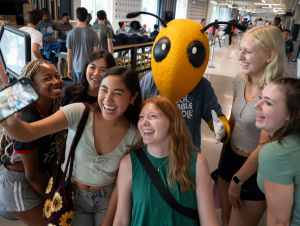
Georgia Tech achieved a record-breaking fundraising year in fiscal year 2026, raising more than $415 million and pushing Transforming Tomorrow: The Campaign for Georgia Tech beyond its $2 billion goal with 18 months remaining. Support from alumni, donors, corporations, foundations, and friends is funding scholarships, fellowships, faculty excellence, groundbreaking research, and transformative campus projects, including new facilities for business, engineering, and athletics. Campaign investments are expanding access to education, advancing artificial intelligence and health research, and strengthening industry partnerships with organizations such as Delta Air Lines and Hyundai Motor Company. The historic fundraising success reinforces Georgia Tech’s position as a leading research university driving innovation, economic growth, and student opportunity.

For the value it offers students, the Institute earned a five-star rating from the publication.
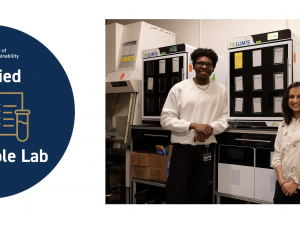
Campus labs have a new pathway to strengthen sustainable operations through a campus comprehensive certification program.
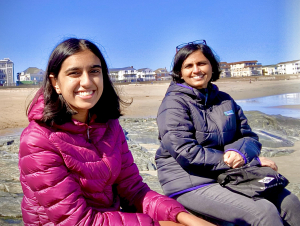
Meghna Iyer (Biology 2026) came to Georgia Tech trying to understand her mother’s illness. What she discovered is changing how scientists connect three neurodegenerative diseases.
Parker H. Petit’s commitment will launch a research hub focused on using artificial intelligence to model diseases, identify treatment paths, and move discoveries closer to patient care.
Meghna Iyer came to Georgia Tech determined to understand the disease that was slowly taking her mother's life. Working with researchers in the Georgia Tech Laboratory for Pathology Dynamics, she helped use AI to analyze 36 million biomedical research papers, uncovering biological connections among ALS, Alzheimer's disease, and frontotemporal dementia. After losing her mother, Meghna returned to the lab with an even stronger resolve to continue the work, earning first-author publication on the study and helping create a tool that could accelerate future research for families facing these devastating diseases.
Experts In The News
For most of the industrial era, spreading crushed limestone across farmland has been treated as a carbon problem. The rock contains carbon; it ends up in contact with air and water, and by the most conservative accounting conventions, carbon is assumed to escape as carbon dioxide. Regulators and major climate assessments have baked that assumption into their default rules for decades.
A study published in Nature now argues that the opposite is true and that the error came from asking the wrong question. Across more than 120 years of records from the Mississippi River Basin, the researchers, including study co-author Chris Reinhard, conclude that agricultural liming has removed somewhere between 300 and 400 million metric tons of carbon dioxide from the atmosphere since 1900.
Intelligent Living September 27, 2026Oceanographer Lily Dove has worked with marine mammals and robots to better understand climate change in Antarctica. In an interview published by Science News Explores, she discusses her experiences and shares advice for students interested in careers in science.
Science News Explores September 23, 2026