To request a media interview, please reach out to experts using the faculty directories for each of our six schools, or contact Jess Hunt-Ralston, College of Sciences communications director. A list of faculty experts is also available to journalists upon request.
News Center
Latest News
The award will support funding aimed at uncovering new insights that could support future coral restoration and disease management efforts.
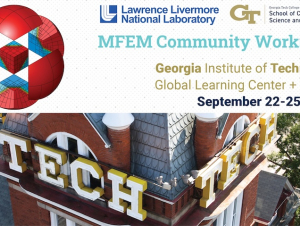
Before building a fusion reactor, designing a new aircraft, or forecasting tsunamis, scientists and engineers test their ideas using computer simulations. The people who create and use the software that powers these simulations are meeting in Atlanta this fall to share best practices and improve their tools.
Georgia Tech is hosting the 2026 MFEM (Modular Finite Element Methods) Community Workshop, Sept. 22-25. MFEM supports research in computational physics, earth systems modeling, engineering, energy, and other fields.
The four-day workshop is being held at the Georgia Tech Global Learning Center and will focus on improving software for scientific computing and discovery. Participants can also attend online. Registration for the workshop is open through Sept. 11.
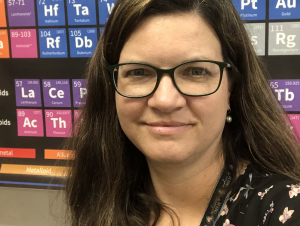
Georgia Tech alumna Kate Sharer is helping high school students move beyond textbooks to explore scientific challenges usually reserved for university and industry researchers.
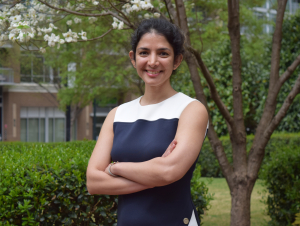
A Georgia Tech study challenges a decades-old explanation for one of neuroscience's most famous signals, revealing an intrinsic neural code for tracking time.
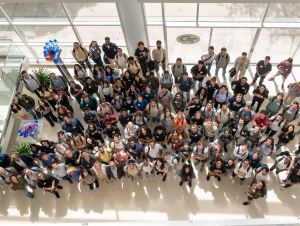
Georgia Tech’s Startup Launch reached a record 200-plus startup teams this year, bringing together students, faculty, researchers, and alumni through CREATE-X and Quadrant-i to turn ideas and research into companies that solve real-world problems.
I especially like the summary because it captures all three pieces of the story: the record, who is behind it, and why it matters. It also avoids calling Startup Launch a “program,” even though the edited story uses that terminology
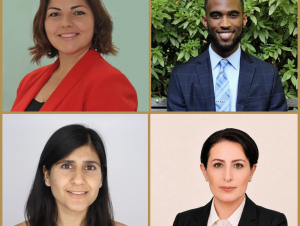
Four Georgia Tech doctoral students spent the summer working on their dissertation research through the Energy Policy and Innovation Center's (EPIcenter) Summer Research Program. The competitive program provides a full summer-semester stipend, along with mentorship and professional development opportunities, to support emerging energy scholars.
"One of the goals of the program is to give students the time and support needed to make meaningful progress on their dissertation research while helping them understand the broader policy, economic, and societal implications of their work," said Laura Taylor, director of EPIcenter.
The stipends enable participants to focus exclusively on clearly defined research goals. The program also supports peer discussions, communication training, and interdisciplinary learning opportunities designed to strengthen both their research and professional development.
This year's cohort explored topics ranging from electricity markets and air pollution to critical mineral supply chains and grid modernization, highlighting the breadth of energy-related research taking place across Georgia Tech.
Experts In The News
Are people who have been blind for most of their lives better at hearing than sighted individuals? In a new study in JNeurosci, Woon Ju Park from the Georgia Institute of Technology and colleagues explored this question by comparing tone detection and pitch discrimination in people with and without sight.
Medical Xpress October 12, 2026For most of the industrial era, spreading crushed limestone across farmland has been treated as a carbon problem. The rock contains carbon; it ends up in contact with air and water, and by the most conservative accounting conventions, carbon is assumed to escape as carbon dioxide. Regulators and major climate assessments have baked that assumption into their default rules for decades.
A study published in Nature now argues that the opposite is true and that the error came from asking the wrong question. Across more than 120 years of records from the Mississippi River Basin, the researchers, including study co-author Chris Reinhard, conclude that agricultural liming has removed somewhere between 300 and 400 million metric tons of carbon dioxide from the atmosphere since 1900.
Intelligent Living September 27, 2026