Chandra Raman is a physicist — and an avid beach volleyball player. In 25 years as a professor in Georgia Tech’s School of Physics, his sport never came up in the classroom. That changed when he joined Quadrant-i, a faculty startup engine, and realized volleyball could help him pitch his startup.
Raman’s company, 8Seven8, produces quantum chips for aircraft navigation and industrial automation. To explain it to investors, he drew on the sport he knows best. “The technology I'm working on needs precision, timing, and teamwork, so I compared that to volleyball,” he said. “You need precision to place the ball, timing to block, and teammates who support you.”
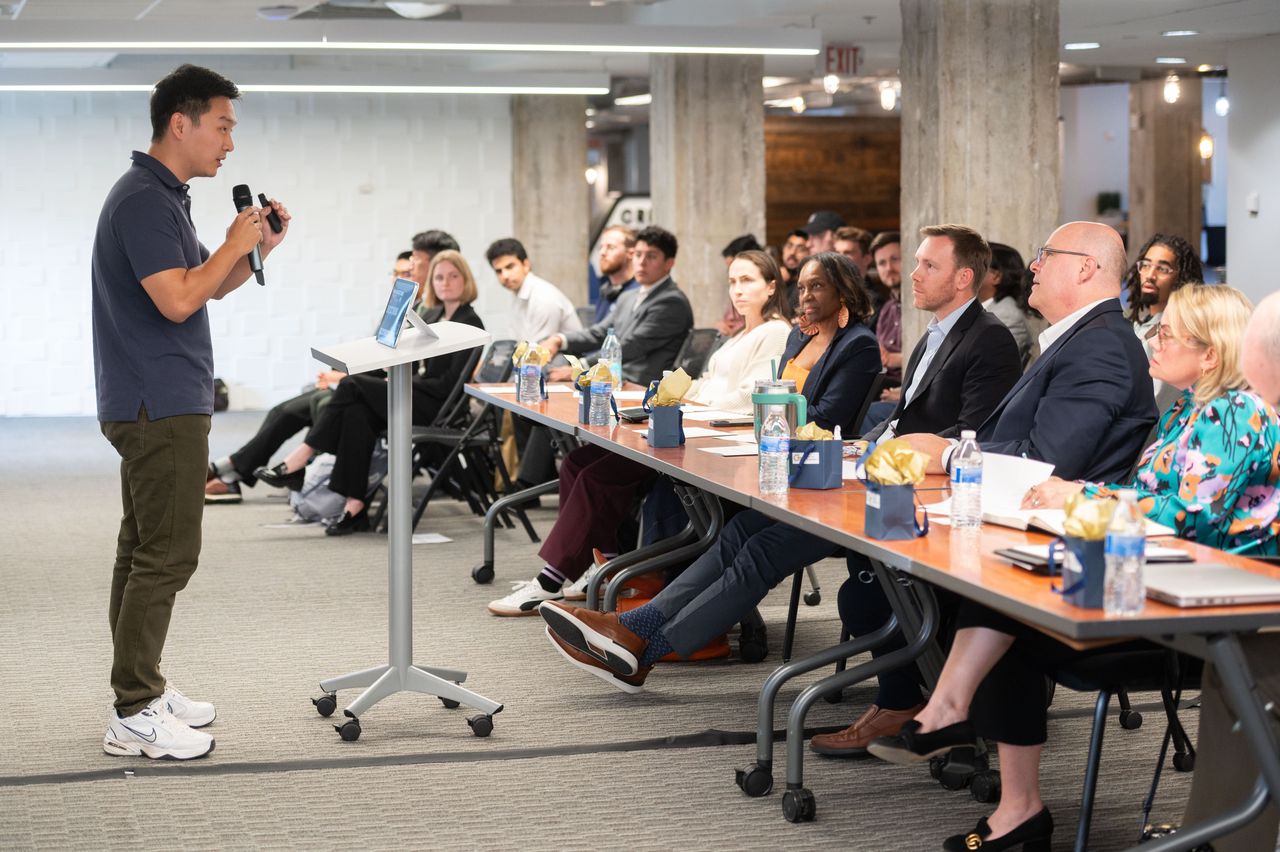
The metaphor helped investors grasp his company’s value, a skill Raman developed in Q-i’s first space-themed cohort, run with the Space Research Institute. The six faculty and student teams learned how to launch startups, from customer discovery to storytelling — soft skills essential to bringing research to market.
“Building a successful startup means recruiting a team, winning customers, and convincing investors, all of which require the ability to rally people behind a world-changing vision,” said Theo Williams III, general partner at Creations VC, a space venture capital firm that funded the cohort. “Soft skills turn brilliant researchers into the kind of leaders people want to follow.”
Sharing the Art of Storytelling
To help faculty connect with investors, Q-i brought in storytelling coaches from Creative Re/Frame, a Boston-based consultancy founded by academics Jen Guillemin and Wendy Swart Grossman. They led a workshop to refine pitches, then worked one-on-one with teams on everything from narrative to presentation.
The biggest hurdle: translating complex research for audiences who aren’t scientists. “We help faculty innovators translate deep knowledge and expertise into relatable human stories that solve real-world problems and create change,” they said.
Faculty quickly saw the payoff.
“Giving customers or investors the story behind a startup shows how invested you are in its success,” said Panagiotis Tsiotras, who leads Penumbra Autonomy, a spacecraft maneuvering startup.
The workshop also reshaped how some participants framed their work. James Read, founder of ferroelectric memory startup CIMTech.ai, said it shifted his focus beyond novelty. “As researchers, you focus on novelty, but you have to ground it in something anyone can understand,” he said. “Quadrant-i pushes you to focus on customer value, not just what’s publishable.”
Discovering the Customer
That focus starts with customer discovery: listening, asking questions, and validating problems before building solutions.
“In research and development, there is a natural tendency to lead with the solution: build something sophisticated and then look for a market that needs it. But customer discovery flips that instinct on its head,” said Mike Yan, whose startup OpenWerks streamlines supply chain management for space industries. “If you haven't validated that a problem is real, urgent, and worth solving from the customer's perspective, you risk building something technically impressive that no one actually needs. The soft skills of listening, empathy, and intellectual humility are what make genuine customer discovery possible.”
For Q-i director Jonathan Goldman, that mindset shift is the point.
“Faculty are best positioned to drive real-world impact by partnering with experienced entrepreneurs,” he said. “They also have to be the first salesperson before hiring one.”
The approach is already paying off. OpenWerks has secured funding from the Georgia Research Alliance and the Defense Logistics Agency and is prototyping with aerospace and defense manufacturers, validating both its technology and its market.
Programs like Q-i show that research doesn’t have to be paradigm-shifting to matter. Sometimes, the key to impact is simple: meeting people where they are with a story they understand.
Related Media
KYEmZ59Q.jpeg
For More Information Contact
Tess Malone, Senior Research Writer/Editor
tess.malone@gatech.edu