To request a media interview, please reach out to experts using the faculty directories for each of our six schools, or contact Jess Hunt-Ralston, College of Sciences communications director. A list of faculty experts is also available to journalists upon request.
News Center
Latest News
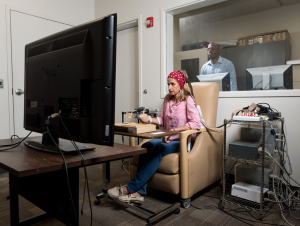
Neuroscience experts from across Georgia Tech will soon come together for a new interdisciplinary research institute, the Institute for Neuroscience, Neurotechnology, and Society (INNS), launched in July. Faculty in INNS are helping to solve some of neuroscience’s most pressing problems, and many have promising medical applications. One important aspect of studying the brain is understanding how the brain and the body work together. Meet the researchers who study brain-body interactions, from monitoring the neuron degradation that causes Alzheimer’s to enhancing mobility for stroke survivors, in an effort to improve the health and quality of life for millions of Americans.
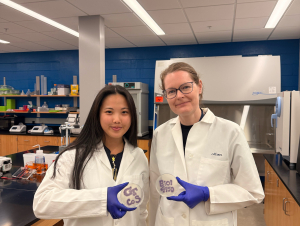
“This course truly underscores Georgia Tech’s commitment to pioneering meaningful undergraduate experiences,” says teacher Vinayak (Vinny) Agarwal. “No other peer institution I know of is exposing undergraduates to bioinformatics at this level.”
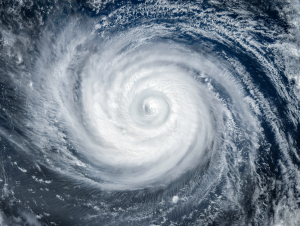
As climate change influences hurricane behavior, experts are taking a closer look at how we classify and communicate storm risks, and what that means for forecasting, preparedness, and public understanding.

Georgia Tech researchers are developing solutions to monitor and forecast flooding, as well as restore ecosystems to prevent future flooding. These efforts support communities’ resilience in the face of climate change and keep the U.S. secure.
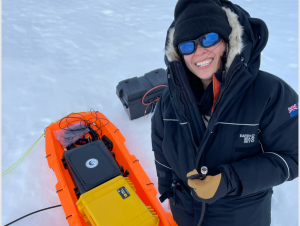
The grant will support Chu as she uses radar data and generative AI to map temperatures beneath the Antarctica ice sheet, aiming to improve climate predictions, support coastal planning, and train future scientists through open-access tools and education.
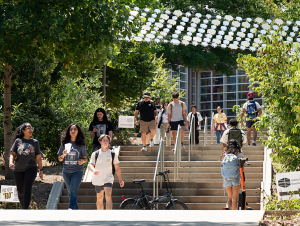
The new bachelor’s degree brings together essential elements of both mathematics and computing training and includes the applications of mathematical theories relevant to computing and data, as well as the theoretical problems and real-world challenges that modern computing addresses.
Experts In The News
In an article published by The Conversation, Professor Joseph Montoya, Postdoctoral Fellow Xing Zhou, and their collaborator discuss sargassum blooms and their impact on the Caribbean and Gulf coasts and the coasts of the tropical Atlantic. According to their research, the vast mats of smelly, brown seaweed affecting these areas may have entered a "self-sustaining cycle, effectively feeding their own expansion."
The Conversation July 28, 2026Researchers in the School of Physics, working with King Fahd University of Petroleum and Minerals, have found that standard methods for identifying chirality in topological phases fail when applied to mixed quantum states. The study reveals that established diagnostics, including bulk-boundary correspondence and the modular commutator, are unreliable in these complex systems. Consequently, the research presents two new measures, based on relative entropy, to accurately diagnose chirality and determine the chiral central charge in decohered topological phases, indicating a need for a new set of tools when investigating mixed-state topology.
Quantum Zeitgeist July 16, 2026