To request a media interview, please reach out to experts using the faculty directories for each of our six schools, or contact Jess Hunt-Ralston, College of Sciences communications director. A list of faculty experts is also available to journalists upon request.
News Center
Latest News
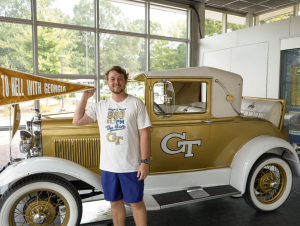
Josh Hembree is the first Ramblin’ Wreck driver to drive the car at his own wedding. He’s also the first transfer student driver in more than a decade.

Humanity’s drive to explore has taken us across the solar system, with astronaut boots, various landers and rovers’ wheels exploring the surfaces of several different planetary bodies. These environments are generally hostile to human and equipment health, so designing and executing these missions requires a lot of planning, testing and technological development.
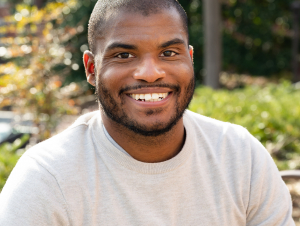
Congratulations to Isaiah Bolden, Jennifer Glass, Alex Robel, and Yuanzhi Tang on their new endowed faculty professorships.
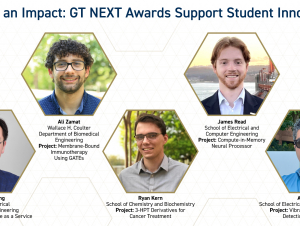
The Office of Technology Licensing has announced the 2025 recipients of the GT NEXT awards, a grant that helps students advance their inventions toward market readiness. Providing early momentum for promising technologies, the grants help students move their research toward real-world impact.
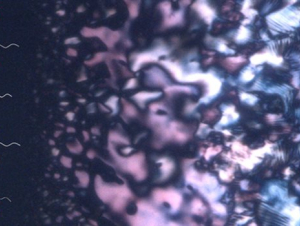
A new study reveals that many conjugated polymers, long considered structurally neutral, can spontaneously twist into chiral shapes. This surprising behavior, overlooked for decades, could pave the way for development of a new class of energy-efficient electronics inspired by nature. Collaborative findings across University of Illinois Urbana-Champaign, Georgia Tech, University of North Carolina, and Purdue University are published in the Journal of the American Chemical Society.
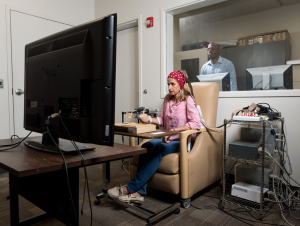
Neuroscience experts from across Georgia Tech will soon come together for a new interdisciplinary research institute, the Institute for Neuroscience, Neurotechnology, and Society (INNS), launched in July. Faculty in INNS are helping to solve some of neuroscience’s most pressing problems, and many have promising medical applications. One important aspect of studying the brain is understanding how the brain and the body work together. Meet the researchers who study brain-body interactions, from monitoring the neuron degradation that causes Alzheimer’s to enhancing mobility for stroke survivors, in an effort to improve the health and quality of life for millions of Americans.
Experts In The News
In an article published by The Conversation, Professor Joseph Montoya, Postdoctoral Fellow Xing Zhou, and their collaborator discuss sargassum blooms and their impact on the Caribbean and Gulf coasts and the coasts of the tropical Atlantic. According to their research, the vast mats of smelly, brown seaweed affecting these areas may have entered a "self-sustaining cycle, effectively feeding their own expansion."
The Conversation July 28, 2026Researchers in the School of Physics, working with King Fahd University of Petroleum and Minerals, have found that standard methods for identifying chirality in topological phases fail when applied to mixed quantum states. The study reveals that established diagnostics, including bulk-boundary correspondence and the modular commutator, are unreliable in these complex systems. Consequently, the research presents two new measures, based on relative entropy, to accurately diagnose chirality and determine the chiral central charge in decohered topological phases, indicating a need for a new set of tools when investigating mixed-state topology.
Quantum Zeitgeist July 16, 2026