
College of Sciences

Latest News

Evolved snowflake yeast

 The grant will enable research into the origin of complex life. 

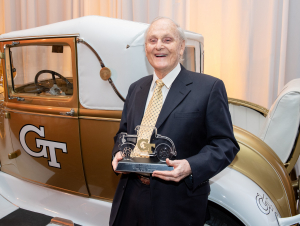
Professor Andrzej Święch

Professor Andrzej Święch is one of only 40 mathematical scientists recognized this year for outstanding contributions to the creation, exposition, advancement, communication, and utilization of mathematics.

Angela Juric with Georgia Tech mascot Buzz

Angela Juric’s childhood changed after her father's workplace accident. Through resilience and a Kids’ Chance scholarship, she's now a third-year biology major pursuing a career in healthcare.

Doby.jpg

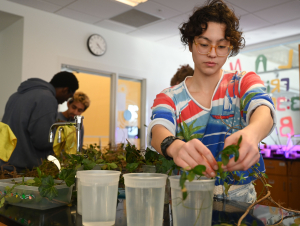
Faculty at Georgia Tech use their expertise in engineering, math, and computer science to apply common principles of these disciplines to neuroscience research. Within the Institute for Neuroscience, Neurotechnology, and Society (INNS),neuroscientists use these quantitative methods to understand how humans think, treat disorders such as Parkinson’s and Alzheimer’s, and better understand psychiatric disorders.

The Canada Jay is one of the birds struggling in the Pacific Northwest. (Credit: Mason Maron)

After discovering a historic bird survey in the Pacific Northwest, Georgia Tech’s Ben Freeman located the original sites, repeating the surveys three decades later. Each day, he would wake up at four in the morning to locate and visit the research areas — often navigating trails, open forest, and rough terrain on foot.

Anton Leykin

Leykin and his international team are developing an AI-powered interface to link proof verification and computational algebra, aiming to transform how mathematicians collaborate and solve complex problems.

Experts In The News

Bacteria have no neurons or memories in the human sense. Yet in a new study, researchers at Georgia Tech and Carnegie Mellon University — including School of Physics Associate Professor Shiladitya Banerjee and Postdoctoral Fellow Josiah Kratz — found that individual E. coli cells carried traces of past hardship into the future. When nutrients repeatedly rose and fell, the cells changed how quickly they grew, suggesting that even simple microbes can use experience to prepare for what may come next. 

ZME Science June 10, 2026

A new Georgia Tech study found the chemical plume from the 2024 BioLab fire in Conyers, Ga., released bromine, not chlorine, as its dominant compound in the immediate aftermath. This finding stands in stark contrast to early public warnings about the fire, which prompted 17,000 evacuations, closed portions of I-20, and led to overnight shelter-in-place orders for weeks. Nearly two years later, the U.S. Chemical Safety Board is still investigating the fire and chemical release. 

The Georgia Tech paper containing the study was published in the March 2026 issue of Environmental Science & Technology Letters and identified 26 different chemical species in the air following the Sept. 29, 2024, fire at the BioLab facility in Conyers. The authors wrote that the chemically complex plume "exposed millions in metropolitan Atlanta to numerous toxic compounds" and represented the first detailed study of a pool chemical facility fire.

GPB June 10, 2026

Upcoming Events

Aug
05
2026
Enjoy curated wines, thoughtfully selected pairing, and a graduate student poster showcase with other College of Sciences alumni and friends of the College.

Spark: College of Sciences at Georgia Tech

Welcome — we're so glad you're here. Learn more about us in this video, narrated by Susan Lozier, College of Sciences Dean and Betsy Middleton and John Clark Sutherland Chair.