Zhigang Peng studies the physics of faulting, earthquake triggering, fault zone structures, earthquakes swarms, slow earthquakes, but lately he’s added a few other topics that veer away from the usual. Vibrations in a sewer pipe. Exploding rock outcrops.
“In particular, what I have been working on the past 20 years is primarily understanding how earthquakes interact with each other, and in some cases, how other processes interact with earthquakes,” explains the professor in the School of Earth and Atmospheric Sciences, who also serves as associate chair for Research and Faculty Development for the School and is incoming president of the Seismological Society of America.
Peng's recent work deploying nodal seismometers in and around Georgia has led him “almost by accident” into the field of environmental seismology.
The rise of nodal seismometers, fiber Distributed Acoustic Sensing (DAS) and machine learning have combined to produce a wealth of seismic data, and “pretty quickly you realize that there are actually quite a lot of non-earthquake events that are also there in the data,” he says.
“If you really wanted to study earthquake events, you better learn to distinguish or throw out those non-earthquake events first. But it turns out that some of those events are also equally interesting or sometimes more interesting, depending on where you are studying,” Peng adds.
Environmental seismologists are turning noise into signal to study a variety of phenomena, from urban traffic to groundwater levels. Peng and his colleagues used seismic sensors to analyze periodic vibrations from shaking homes nearly every six minutes in a neighborhood outside of Atlanta, for instance, discovering that a faulty check valve in a sewer pipe was producing a water hammer effect.
And then there are the exploding rocks. In July 2023, there was a violent spalling of rock off the face of Arabia Mountain in Georgia that scattered large chunks of gneiss. “Normally on these outcrops the outer layer of bare rock can peel off slowly, but in some cases they kind of blast off violently and generate some ground shaking,” Peng says.
Related Media
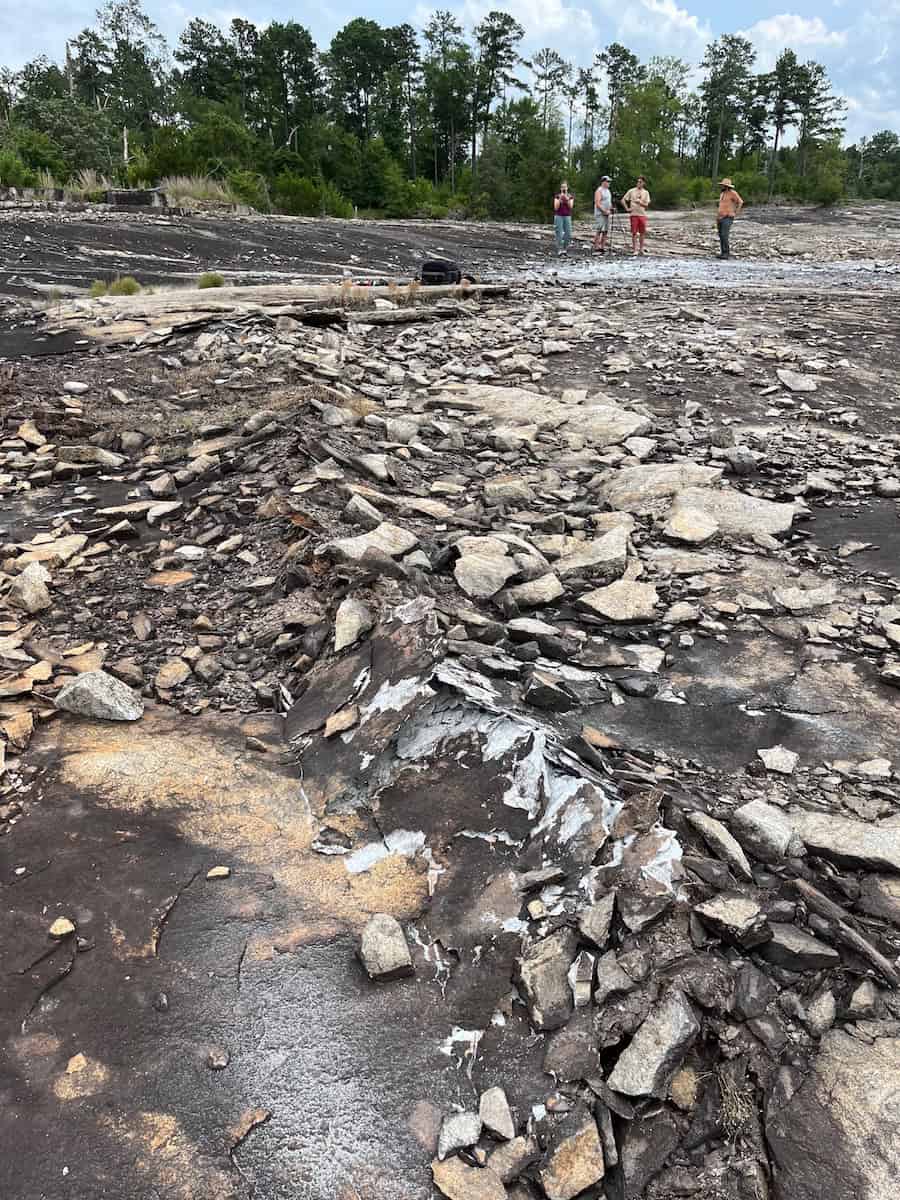
Fresh fault outcrop (Arabia Mountain National Heritage Area)