To request a media interview, please reach out to experts using the faculty directories for each of our six schools, or contact Jess Hunt-Ralston, College of Sciences communications director. A list of faculty experts is also available to journalists upon request.
News Center
Latest News
Featuring world-leading mathematicians at the forefront of their fields, ICM 2026 will be held in Philadelphia, Pennsylvania in July. Known for his expertise, Etnyre will speak on the topic of Geometry.
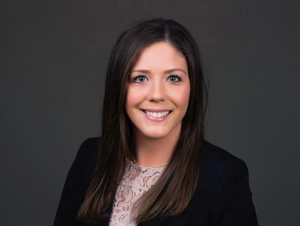
School of Psychology faculty member and academic advisor Meghan Babcock has been selected to receive NACADA: The Global Community for Academic Advising's Outstanding Faculty Advisor Award. Earlier this year, Babcock was awarded Georgia Tech's Outstanding Undergraduate Academic Advisor – Faculty Honor.
The new center will promote research and collaboration focused on using state-of-the-art artificial intelligence and machine learning techniques to address complex scientific challenges.
This June, New York City’s government and utility urged households to conserve electricity during an extreme heat wave with temperatures reaching 100 degrees F. People were asked to set air conditioners to 76 degrees, to avoid using more than one air conditioning unit, and to delay using electricity-hungry appliances during peak cooling hours.
The big concern is that when every air conditioning unit is running at full blast, electricity demand can exceed total generating capacity and force the utility to implement rolling blackouts. These rolling blackouts avoid a total system failure but leave people without access to cooling and other electronics as temperatures reach dangerous levels.
As temperatures peak in the United States during the coming weeks, utilities and city governments may follow suit with similar requests for voluntary conservation. Voluntary requests for conservation in the United States are part of the standard energy emergency playbook and go back at least to President Carter’s request for Americans to reduce heating temperatures during the 1977 energy crisis.
So, do voluntary conservation requests work to save energy and prevent blackouts?
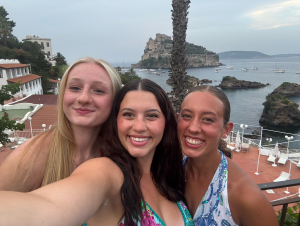
Georgia Tech’s inaugural summer study abroad program in southern Italy offered students a unique opportunity to research the science and culture of stress and well-being — while soaking in the Mediterranean sun.
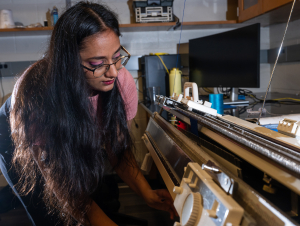
Researchers in the School of Physics unravel the secrets of the centuries-old practice of knitting in a new study that explores the physics of ‘jamming’ — a phenomenon when soft or stretchy materials become rigid under low stress but soften under higher tension.
Experts In The News
In an article published by The Conversation, Professor Joseph Montoya, Postdoctoral Fellow Xing Zhou, and their collaborator discuss sargassum blooms and their impact on the Caribbean and Gulf coasts and the coasts of the tropical Atlantic. According to their research, the vast mats of smelly, brown seaweed affecting these areas may have entered a "self-sustaining cycle, effectively feeding their own expansion."
The Conversation July 28, 2026Researchers in the School of Physics, working with King Fahd University of Petroleum and Minerals, have found that standard methods for identifying chirality in topological phases fail when applied to mixed quantum states. The study reveals that established diagnostics, including bulk-boundary correspondence and the modular commutator, are unreliable in these complex systems. Consequently, the research presents two new measures, based on relative entropy, to accurately diagnose chirality and determine the chiral central charge in decohered topological phases, indicating a need for a new set of tools when investigating mixed-state topology.
Quantum Zeitgeist July 16, 2026