

College of Sciences

Latest News

Yuanzhi Tang

Georgia Tech has appointed Yuanzhi Tang as executive director of the Strategic Energy Institute (SEI), effective Feb. 1.

Tang will lead the strategic vision, interdisciplinary research efforts, and internal and external partnerships at SEI, strengthening connections across Georgia Tech’s Colleges, Interdisciplinary Research Institutes (IRI), the Georgia Tech Research Institute (GTRI), and external partners to advance energy-related initiatives.

During a 2025 “Making Science Accessible” event, CoSYAB members provided feedback to graduate students testing new ways of presenting their research to the public.

Launched in fall 2024, the volunteer leadership group is composed of alumni who obtained an undergraduate degree from the College within the past two decades or a master’s or Ph.D. degree within the past decade.

From L to R: Krishna Monroe, president of EMS at GT; Lianna Homrich, vice president of EMS at GT;  Daeun “Esther” Lee, outreach director of EMS at GT; and Brandon Brigner, CPR officer of EMS at GT.

Four Georgia Tech students share what it’s like to balance rigorous coursework with the high-stakes world of emergency medicine.

Community Engagement Graduate Fellows

Four graduate students from the College of Sciences were selected for the new Community Engagement Graduate Fellowship, made possible through a gift from Google, to develop projects that positively impact the metro Atlanta area and highlight how science can align with public good.

Degraded marsh on Cumberland Island, Georgia.

The award will support the design of nature-based solutions including living shorelines and marsh restoration in flood-prone areas of Camden County, Georgia.

Armita Manafzadeh

Manafzadeh will join Georgia Tech as an assistant professor in the School of Biological Sciences in August 2026. The new Manafzadeh Lab at Georgia Tech will investigate how joints work and where they come from — both evolutionarily and developmentally. 


Experts In The News

Bacteria have no neurons or memories in the human sense. Yet in a new study, researchers at Georgia Tech and Carnegie Mellon University — including School of Physics Associate Professor Shiladitya Banerjee and Postdoctoral Fellow Josiah Kratz — found that individual E. coli cells carried traces of past hardship into the future. When nutrients repeatedly rose and fell, the cells changed how quickly they grew, suggesting that even simple microbes can use experience to prepare for what may come next. 

ZME Science June 10, 2026

A new Georgia Tech study found the chemical plume from the 2024 BioLab fire in Conyers, Ga., released bromine, not chlorine, as its dominant compound in the immediate aftermath. This finding stands in stark contrast to early public warnings about the fire, which prompted 17,000 evacuations, closed portions of I-20, and led to overnight shelter-in-place orders for weeks. Nearly two years later, the U.S. Chemical Safety Board is still investigating the fire and chemical release. 

The Georgia Tech paper containing the study was published in the March 2026 issue of Environmental Science & Technology Letters and identified 26 different chemical species in the air following the Sept. 29, 2024, fire at the BioLab facility in Conyers. The authors wrote that the chemically complex plume "exposed millions in metropolitan Atlanta to numerous toxic compounds" and represented the first detailed study of a pool chemical facility fire.

GPB June 10, 2026

Upcoming Events

Jul
29
2026
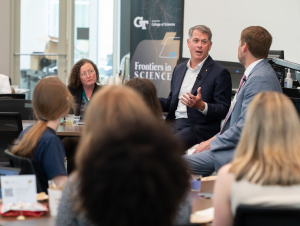
This event series aims to showcase research taking place in the College of Sciences to the wider science community.
Aug
05
2026
Enjoy curated wines, thoughtfully selected pairing, and a graduate student poster showcase with other College of Sciences alumni and friends of the College.

Spark: College of Sciences at Georgia Tech

Welcome — we're so glad you're here. Learn more about us in this video, narrated by Susan Lozier, College of Sciences Dean and Betsy Middleton and John Clark Sutherland Chair.