College of Sciences

Latest News

hiddencostAdobeStock_669231771-1536x1023.jpeg

A new study by EPIcenter affiliate Marilyn A. Brown and coauthor Majid Ahmadi examines how racial segregation affects what households pay for basic utilities. Using detailed data from Atlanta, Georgia, the authors investigate whether predominantly Black neighborhoods face higher energy burdens only because of income and housing differences, or whether segregation itself plays a direct role. Their analysis combines mortgage denial data, housing information, utility costs, and household income to show how long-standing discriminatory housing and lending practices continue to shape energy affordability today.

Alex Robel

The CHORUS research project will combine advanced flood modeling, artificial intelligence, and community partnerships to help coastal residents in Georgia and New York evaluate flooding solutions and shape resilience planning.

2026 Distinguished Alumni Award honorees

Congratulations to the 2026 Distinguished Alumni Award winners.
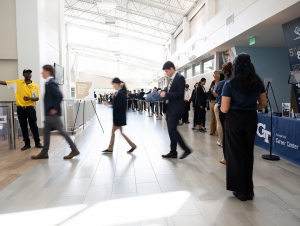
Career Fair at the Campus Recreation Center

The Georgia Tech Career Center offers a few tips for students attending the fair. Most importantly — mark your calendar for Sept. 14 – 15 from 10 a.m. to 4 p.m. at the Campus Recreation Center.  

2026_BBISS_Fellows_Collage.jpg

Jennifer Bowen, assistant professor in the School of Earth and Atmospheric Sciences, is among the nine faculty fellows selected by the Brook Byers Institute for Sustainable Systems (BBISS).
Emily Weigel

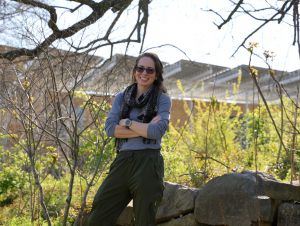
This fall, Emily Weigel (Biology 2010) returned to the G. Wayne Clough Tech Promise Scholars Program to serve as a faculty guide for the next generation of scholars. Weigel was one of the inaugural recipients of the scholarship when she was an undergraduate at the Institute.
Experts In The News

For most of the industrial era, spreading crushed limestone across farmland has been treated as a carbon problem. The rock contains carbon; it ends up in contact with air and water, and by the most conservative accounting conventions, carbon is assumed to escape as carbon dioxide. Regulators and major climate assessments have baked that assumption into their default rules for decades.

A study published in Nature now argues that the opposite is true and that the error came from asking the wrong question. Across more than 120 years of records from the Mississippi River Basin, the researchers, including study co-author Chris Reinhard, conclude that agricultural liming has removed somewhere between 300 and 400 million metric tons of carbon dioxide from the atmosphere since 1900.

Intelligent Living September 27, 2026

Oceanographer Lily Dove has worked with marine mammals and robots to better understand climate change in Antarctica. In an interview published by Science News Explores, she discusses her experiences and shares advice for students interested in careers in science.

Science News Explores September 23, 2026

Upcoming Events

Oct
12 to 13
2026
Avant South is an annual event supporting Atlanta’s growth as a leading tech hub.
Oct
15
2026
Featuring | Saiprasad Ravishankar - Departments of Computational Mathematics, Science and Engineering and Biomedical Engineering at Michigan State University
Oct
15
2026
Featuring | Saiprasad Ravishankar - Departments of Computational Mathematics, Science and Engineering and Biomedical Engineering at Michigan State University
Oct
16
2026
Join the Spatial Ecology and Paleontology Lab for Fossil Fridays. Become a fossil hunter and help discover how ecosystems have changed over time.
Oct
16
2026
Join us every Friday that classes are in session for the Plant Library. We open 3:30 - 4:30 pm to plant seeds, take cuttings, nurture plants, and distribute plants that are ready to take home.

Spark: College of Sciences at Georgia Tech

Welcome — we're so glad you're here. Learn more about us in this video, narrated by Susan Lozier, College of Sciences Dean and Betsy Middleton and John Clark Sutherland Chair.